
The Didache - Two Ways

The “Two Ways” section of the Didache has led scholars to favor it as an early Jewish text due to its distinctly Jewish style and context. It is not surprising that a document from the first century of the early church would sound closely tied to Judaism, as it was written by Jews / people of ‘The Way’ who were immersed in their faith and traditions.

Not a New Religion

As discussed in our introductory text on the Didache and previous post, the apostles never set out to start a new religion. Substantial proof of this exist within the Apostolic Writings (New Testament). A simple example of this can be found in the book of Acts.

And Kĕpha and Yoḥanan were going up to the Set-apart Place at the hour of prayer, the ninth hour.

In Jewish tradition, it is customary to attend temple services three times daily for prayer. Acts 3:1 provides evidence that even after Yashua’s death and resurrection, the disciples continued to practice ‘The Way’ and keep Torah. They did not seek to establish a new religion outside of ‘The Way’; instead, they remained deeply immersed in Torah living, guided by its principles. This supports Yashua’s statement: “I have not come to destroy the Torah or the prophets!”

17 Do not think that I came to destroy the Torah or the Prophets. I did not come to destroy but to complete. 18 For truly, I say to you, till the heaven and the earth pass away, one yod or one tittle shall by no means pass from the Torah till all be done. 19 “Whoever, then, breaks one of the least of these commands, and teaches men so, shall be called least in the reign of the heavens; but whoever does and teaches them, he shall be called great in the reign of the heavens.

Two Ways

The concept of the ‘Two Ways’ reasoning has deep roots within Hebrew culture and the people of the set-apart way. The disciples of the master would have been familiar with this stye of teaching. Similarly, it’s more than an individual challenge that say’s right or wrong which will you choose, but it’s a call-to-action for the community of believers. It’s a mandate that falls on the shoulders of every member to live and walk in the light of His Word. The same as it was then is still the same today. We as a member of the community have responsibility as members of The Way, but the community as a whole has to set out to walk in it. When individuals go off the straight and narrow path it jeopardizes the entire community.

An example of this is when you hear about such and such fellowship, and someone says to you “Oh isn’t that the fellowship that does this or that”. The “this or that” in reference may have been an individual or a few, but the community as a whole get’s labeled.

The early church was rooted in the centrality of community

Two Ways - Salt of the Earth Ministries

44 And all those who believed were together, and had all in common,  45 and sold their possessions and property, and divided them among all, as anyone might have need.  46 And day by day, continuing with one mind in the Set-apart Place, and breaking bread from house to house, they ate their food with gladness and simplicity of heart,  47 praising Elohim and having favour with all the people. And the Master added to the assembly those who were being saved, day by day. 

Two Ways References

Let’s take a look at some examples of ‘Two Ways’ thinking found in scripture and other writings.

26 See, I am setting before you today a blessing and a curse: 27 the blessing, when you obey the commands of YHWH your Elohim which I command you today; 28 and the curse, if you do not obey the commands of יהוה your Elohim, but turn aside from the way which I command you today, to go after other mighty ones which you have not known.

15 See, I have set before you today life and good, and death and evil,” 16 in that I am commanding you today to love יהוה your Elohim, to walk in His ways, and to guard His commands, and His laws, and His right-rulings. And you shall live and increase, and יהוה your Elohim shall bless you in the land which you go to possess. 17 “But if your heart turns away, and you do not obey, and shall be drawn away, and shall bow down to other mighty ones and serve them, 18 “I have declared to you today that you shall certainly perish, you shall not prolong your days in the land which you are passing over the Yardĕn to enter and possess.

8 “You shall also say to this people, ‘Thus said יהוה, “See, I set before you the way of life and the way of death.

6 For YHWH knows the way of the righteous, But the way of the wrong comes to naught.

3 Two ways hath God given to the sons of men, and two inclinations, and two kinds of action, and two modes of action, and two issues. 4 Therefore all things are by twos, one over against the other. 5 For there are two ways of good and evil, and with these are the two inclinations in our breasts discriminating them.

14 Do not enter the path of the wrong, And do not walk in the way of evil-doers. 15 Avoid it, do not pass by it; Turn away from it and pass on. 16 For they do not sleep unless they have done evil. And their sleep is taken away unless they make someone fall. 17 For they have eaten the bread of wrongdoing, And they drink the wine of violence. 18 But the path of the righteous is like the light of dawn, That shines ever brighter unto the perfect day. 19 The way of the wrong is like darkness; They do not know at what they stumble.

1 And now I say unto you, my sons, love righteousness and walk therein; For the paths of righteousness are worthy of acceptation, But the paths of unrighteousness shall suddenly be destroyed and vanish. 2 And to certain men of a generation shall the paths of violence and of death be revealed, And they shall hold themselves afar from them, And shall not follow them. 3 And now I say unto you the righteous: Walk not in the paths of wickedness, nor in the paths of death, And draw not nigh to them, lest ye be destroyed. 4 But seek and choose for yourselves righteousness and an elect life, And walk in the paths of peace, And ye shall live and prosper. 5 And hold fast my words in the thoughts of your hearts, And suffer them not to be effaced from your hearts;

Love of Elohim and Love of Neighbor

The foundation of the Way of Life is twofold. Yashua made this clear to His disciples, which was a well known concept and practice within the Torah community and the people of Yisrael. Quoting from the Shema in Deuteronomy 6:5 Yashua instructs his disciples in Matthew 22:37-39

“And you shall love יהוה your Elohim with all your heart, and with all your being, and with all your might.

37 And Yashua said to him, " ‘You shall love יהוה your Elohim with all your heart, and with all your being, and with all your mind.’ 38 “This is the first and great command. 39 And the second is like it, ‘You shall love your neighbor as yourself.’

For more on the Shema you can access our post The Greatest Commandments here.

Just as it was in the days of Moses, leading up to Yashua and His disciples and now with us. We are presented with two choices: the way of the covenant which leads to life and the way of death which is the choice to ignore the commandments.

This is a challenge for us as individuals but also for the community. The ancient path of the Two Ways is not just a set of do’s and don’ts but the basis of a formal relationship with YHWH our Elohim. Our relationship with Him is established with covenant promises on both sides.

Rules & Relationship

In approaching the Didache we must not forget about YHWH’s relationship with His people. If we do forget, we rely independently on a set of rules that we are to adhere to too.

Looking back it was YHWH who came to Moses and said;

“I am the Elohim of your father, the Elohim of Abraham, the Elohim of Yitsḥaq, and the Elohim of Ya‛aqoḇ.”

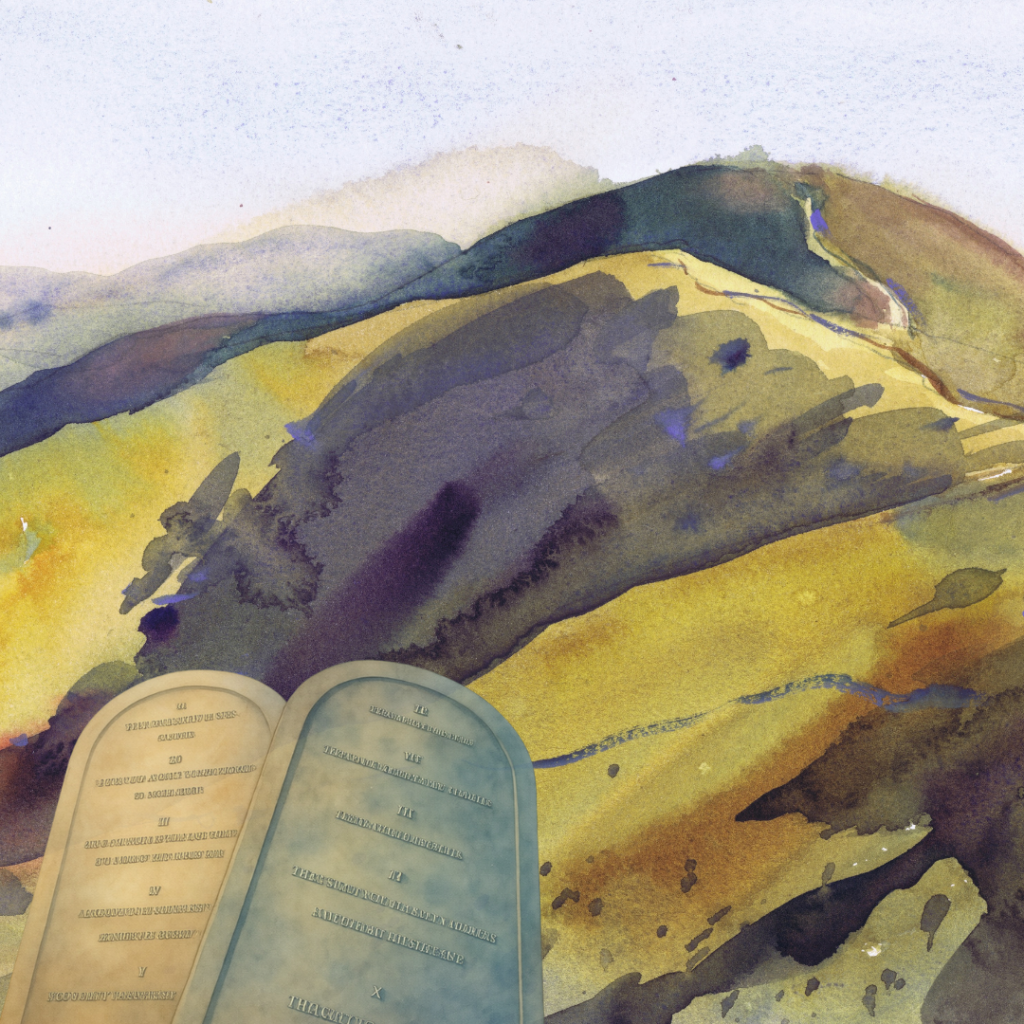
Mount Sinai with the two stone tablets

YHWH then delivered His people from the bonds of slavery and did mighty acts before them proving to the Hebrews and the Egyptians that He is the only true Elohim. All of this took place prior to the Torah. It was YHWH redeeming His people back to Him in covenant relationship that He established with Abraham, Yitshaq, and Ya’aqob. This was not based upon a set of rules and regulations it was all about Yah being faithful to His word and His covenant.

It was only when He established a covenant with the Hebrews at the foot of the mount Sinai that the Hebrews entered into a covenant relationship with their creator. Notice covenants were never cancelled, but built upon one another. Example: The Sinai covenant did not cancel the covenant with Abraham, nor did the Davidic covenant cancel the Sinai covenant.

3 And Mosheh went up to Elohim, and יהוה called to him from the mountain, saying, “This is what you are to say to the house of Ya‛aqoḇ, and declare to the children of Yisra’ĕl: 4 ‘You have seen what I did to the Mitsrites, and how I bore you on eagles’ wings and brought you to Myself. 5 ‘And now, if you diligently obey My voice, and shall guard My covenant, then you shall be My treasured possession above all the peoples – for all the earth is Mine – 6 ‘and you shall be to Me a reign of priests and a set-apart nation.’ Those are the words which you are to speak to the children of Yisra’ĕl.” 7 And Mosheh came and called for the elders of the people, and set before them all these words which יהוה commanded him. 8 And all the people answered together and said, “All that יהוה has spoken we shall do.” So Mosheh brought back the words of the people to יהוה.

Here in verse 8 of Exodus 19 the people answered together and said “All that YHWH has spoken we shall do”. This then set into motion a two sided relationship with covenant responsibilities on both sides.

Obedience was presented not as simply adherence to rules but as keeping one side of a bargain within a whole relationship with God. We tend to break religion into ‘relationship’ and ‘rules’ - but we cannot understand the Didache if we start with such a distinction. The Didache can start with a set of rules because it presupposes a relationship: the rules show the parameters of the relationship one is choosing.
Thomas O’Loughlin
Professor of Historical Theology at the University of Nottingham

Conclusion

The concept of the ‘Two Ways’ had deep meaning in the early church. Even after following Yashua it was a continuation of Torah life that left two choices. The way of life or the way of death that leads to destruction. The ‘Two Ways’ are still just as relevant today as ever before. Everyday followers of ‘The Way’ are faced with this question. Which one will you choose?

Stay Salty!
The Didache - The Early Church's Ancient Teaching

The Didache – The Early Church’s Ancient Teaching

The Didache, also known as “The Teaching of the Twelve Apostles,” stands as one of the earliest and most mysterious documents in the history of the early church. Its text, shorter in length yet far reaching in impact, offers a window into the beliefs, observances, and community halakha of the earliest followers of Yahshua.


Read More »
City Skyline

The Great Battle

The goal of this fallen world is the same as that faithful day in the garden. The alure and attraction of this world pulls believers and unbelievers alike into its grips through wealth, status, friends, religion, ETC. The enemy’s plan has not changed since the garden; he’s only become stealthier and more deceitful. The battle that started has only become more intense and with an enemy harder to target. The Word warns us not to become like the world, but to imitate our Messiah and to walk in the spirit which is full of life and peace.

Read More »
Our Way or Yah's Way

Our Way or Yah’s Way

Much like Moses, you may find yourself feeling discouraged, confused, and questioning where Yah is in your life. We all experience these moments, and often, the most heartfelt prayers come when we feel completely empty and simply ask for help. It’s in these times of humility, when we realize that there is nothing we can do on our own, that we must fully depend on and trust Him.

Read More »

If this ministry has blessed you, please consider donating HERE